
Vibe Coding Weekly #17
Vibe Coding Weekly is your definitive source for staying current with the latest trends, tools, and techniques that are transforming the development landscape.

Happy Friday!
Welcome to edition #17 of Vibe Coding Weekly.
This week in one satisfying refactor:
The Big Story: Claude Code hits viral status with Fortune cover—adopted internally at Microsoft, Netflix, Uber, and Spotify
The Release: GitHub makes OpenCode official, adding CLI tools get major upgrades across Cursor, Cline, and Copilot
The Platform: Replit launches mobile app development with natural language—no native experience required
This week marked AI coding’s mainstream moment: Claude Code went viral with Fortune coverage and enterprise adoption, while every major CLI tool—GitHub, Cursor, Cline—shipped significant updates in what’s becoming the fiercest battleground for AI development. The data tells a paradoxical story: 84% of developers now use AI tools and 42% of code is AI-generated, yet 96% still don’t fully trust the output. The race has shifted from raw capability to reliability.
Key Takeaways
Claude Code’s enterprise breakout: From research preview to production at Microsoft, Netflix, Uber, and Spotify in six months. Anthropic Labs produced multiple hits—MCP at 100M monthly downloads, Skills, and Cowork—showing their experimental product strategy is working.
OpenCode gets GitHub’s blessing: Official Copilot integration removes licensing friction for the open source coding agent, which already surpassed Claude Code in GitHub stars in early January.
CLI tools ship massive updates: Cursor added Cloud Agents and Plan mode, Cline v4.0 introduced YOLO autonomous mode, GitHub Copilot CLI integrated GPT-5.2-Codex with auto-compression at 95% token limits. Terminal-native workflows are maturing fast.
Vibe coding hits mainstream: 72% of developers use AI daily, 42% of committed code is AI-generated. Linus Torvalds used Google Antigravity to vibe code a component of his AudioNoise project, demonstrating acceptance at the highest levels.
Trust gap persists despite adoption: While 84% of developers use AI tools, 96% don’t fully trust the code is correct. The workflow is shifting from “writing code” to “reviewing AI-generated code.”
Mobile development goes no-code: Replit’s natural language mobile app builder requires no native development experience, targeting RevOps professionals and citizen developers who’ve saved 90% of time on workflow automation.
📦 Releases & News
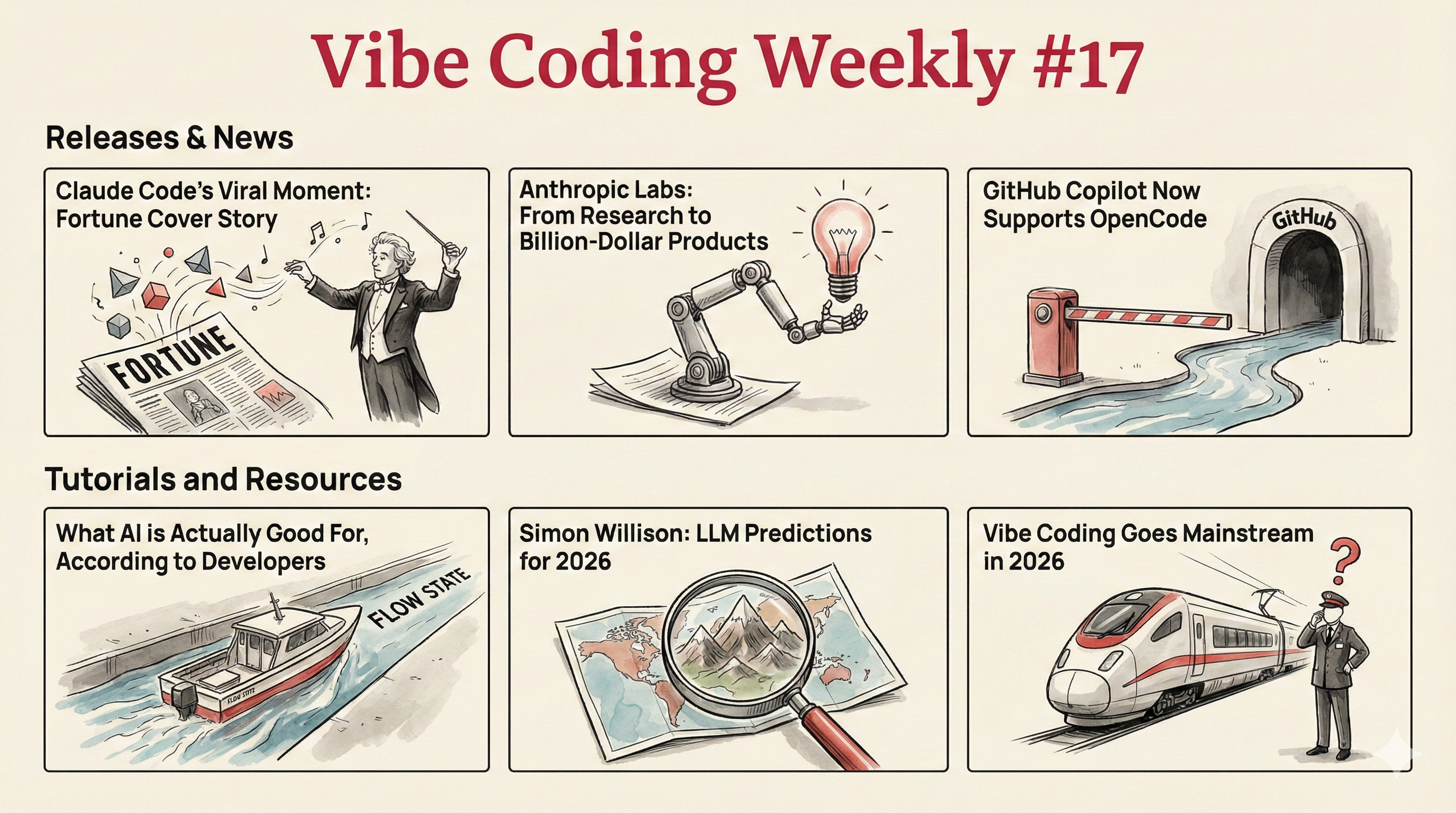
Claude Code’s Viral Moment: Fortune Cover Story
Fortune explores Claude Code’s breakout success story in a major feature published January 24. Jensen Huang called it “incredible” and urged companies to adopt it. A senior Google engineer said it recreated a year’s worth of work in an hour. Users without programming backgrounds have deployed it to book theater tickets, file taxes, and monitor tomato plants. The tool is now used by Uber, Netflix, Spotify, Salesforce, Accenture, and Snowflake—and even at Microsoft, which sells GitHub Copilot, Claude Code has been widely adopted internally across major engineering teams.
Anthropic Labs: From Research to Billion-Dollar Products
Anthropic officially announced the expansion of Anthropic Labs, a team focused on incubating experimental products at the frontier of Claude’s capabilities. The track record is impressive: Claude Code grew from research preview to billion-dollar product in six months, the Model Context Protocol (MCP) hit 100M monthly downloads and became the industry standard, and the team also shipped Skills, Claude in Chrome, and Cowork. This approach validates that rapid experimentation at the model frontier can create new product categories faster than traditional development cycles.
GitHub Copilot Now Supports OpenCode
GitHub made it official on January 16: OpenCode is now authenticated through GitHub Copilot credentials for all paid subscription tiers (Pro, Pro+, Business, Enterprise). Developers can use the open source terminal-based AI agent without requiring an additional AI license. This removes a major adoption barrier for OpenCode, which had already been overtaking Claude Code in GitHub stars according to early January trending reports. The integration includes two built-in agents: “build” for full development work and “plan” for read-only code analysis.
GitHub Copilot CLI: GPT-5.2-Codex and Auto-Compression
GitHub shipped a major CLI update on January 14 with GPT-5.2-Codex and GPT-4.1 models included in Copilot subscriptions without consuming premium requests. The standout feature: automatic context compression at 95% token limit, preventing overflow without manual intervention. New capabilities include a web_fetch tool for retrieving content as markdown, GitHub MCP server with Copilot Spaces tools for project-specific context, and package manager installations that auto-update. Copilot CLI is now included in the default GitHub Codespaces image and available as a Dev Container Feature.
Copilot SDK Enters Technical Preview
GitHub released the Copilot SDK in technical preview on January 14, providing language-specific SDKs for programmatic access to the GitHub Copilot CLI. The SDK is available in Node.js/TypeScript, Python, Go, and .NET, enabling developers to build custom tooling and integrations on top of Copilot’s capabilities. This moves Copilot beyond IDE extensions into a platform that developers can extend and embed in their own workflows.
Cursor CLI: Plan Mode and Cloud Agents
Cursor released a major CLI update on January 16 that brings editor-loved features to the terminal. Plan mode lets you design your approach before coding, with Cursor asking clarifying questions to refine the plan. Cloud Agents allow pushing local conversations to the cloud so work continues while you’re away, accessible on web or mobile at cursor.com/agents. The update adds word-level highlighting to show exactly what changed and MCP integration with automatic callback handling and an interactive menu to browse, enable, and configure MCP servers.
Cline v4.0: Autonomous YOLO Mode
Cline shipped v4.0 in early January with significant autonomy and performance improvements. YOLO mode gives full autonomy to the AI agent, executing commands without permission prompts when toggled on. A major performance boost for diff edits eliminates lag on files with many changes. New API provider integrations include XAI (Grok 3 models), DeepSeek, Ask Sage, and Alibaba Quinn. Local Chrome integration enables session-based browsing with authenticated websites, allowing Cline to summarize information from logged-in dashboards and tools.
Microsoft Copilot Studio Extension for VS Code Goes GA
The Copilot Studio extension reached general availability on January 14, allowing developers to build and manage Copilot Studio agents directly from VS Code with agent-as-code development. Agent definitions are represented in structured YAML with syntax highlighting and IntelliSense completion. Developers can clone agent definitions, version them in Git, integrate into deployment pipelines, and sync updates to the cloud. The extension works with GitHub Copilot, Claude Code, or any VS Code AI assistant to draft topics, update tools, and fix issues. Downloaded more than 13,000 times and available for free on the VS Code Marketplace.
Replit: Build Mobile Apps with Natural Language
Replit launched on January 15 a new way to build and publish mobile apps using natural language, requiring no native development experience or complex setup. The announcement signals Replit’s expansion beyond web development into mobile, leveraging the same AI-native approach that drove their 53x revenue growth in under a year. Separately, Replit published data on January 14 showing RevOps professionals saving 90% of time on processes like mock data generation and HubSpot syncing using Replit-built micro tools.
LangGraph v1.0.7: Resumable Streams and Enhanced Reliability
LangChain shipped LangGraph v1.0.7 on January 22 and LangGraph CLI v0.4.12 on January 23, adding support for resumableStreams on remote graphs and undeprecating toolsCondition. RemoteCheckpointer was implemented to enable subgraph checkpointing, enhancing task execution reliability. On January 16, LangChain introduced Pairwise Annotation Queues in LangSmith, providing a fast, structured way to compare two agent outputs side-by-side for evaluation. The updates show continued refinement of the agent framework with a focus on production reliability.
Windsurf Integrates GPT-5.2-Codex
Windsurf added support for GPT-5.2-Codex on January 14 with four reasoning efforts: low, medium, high, and xhigh. GPT-5.2-Codex is OpenAI’s latest model designed for agentic coding and excels at working in large codebases over long sessions. Version 1.13.9 on January 16 brought improvements to the GPT-5.2-Codex harness and introduced administrative capabilities for Windows Group Policy. Windsurf also added Agent Skills for Cascade on January 12, their AI coding agent feature.
📚 Tutorials and Resources
What AI is Actually Good For, According to Developers
GitHub published research on January 13 exploring what developers actually want from AI tools. The answer: a smoother, less interrupted path toward flow—that state where code and ideas come easily. Developers don’t want AI to “think for them” but to remove friction in the coding process. The research informs design of AI features where developers work best: in the editor, the terminal, or during code review. The piece challenges the narrative that AI will “replace” developers, focusing instead on how AI can amplify the flow state that makes developers most productive.
Simon Willison: LLM Predictions for 2026
Simon discusses how automated code generation is being automated away, but “everything else” in engineering is becoming larger—debugging, testing, architecture decisions, code review, security analysis. He poses a critical question: will driving down the cost of producing code devalue engineering careers or increase demand for software by a factor of 10? His bet is on the latter, as cheaper code production unlocks problems that were previously economically unfeasible to solve.
Vibe Coding Goes Mainstream in 2026
Tech Monitor analyzes the mainstream adoption of vibe coding with compelling statistics: 72% of developers who have tried AI now rely on it daily, and 42% of all committed code is AI-generated, a figure developers believe will rise to 55% this year and 65% next year. High-profile usage includes Linus Torvalds using Google Antigravity to vibe code a component of his AudioNoise project. The widespread industry adoption shows AI now writes as much as 30% of Microsoft’s code and more than a quarter of Google’s. Despite rapid adoption, 96% of developers don’t fully trust that AI-generated code is functionally correct.
AI Pair Programming Statistics: 84% Developer Adoption
Comprehensive 2026 statistics reveal 84% of developers now use AI coding tools, with 65% using them at least weekly and 41% of all code being AI-generated or AI-assisted. Developers who master these tools achieve 25-40% productivity gains while maintaining or improving code quality. Research shows AI pair programming can cut development time by up to 55%. Developers using GitHub Copilot were 53.2% more likely to pass all unit tests and Copilot-authored code contained 13.6% fewer errors per line than code written without AI assistance.
DeepSeek R1 Architecture Secrets and V4 Preview
DeepSeek expanded its R1 whitepaper by 60 pages to disclose training secrets, clearing the path for a rumored V4 model launch in mid-February. R1 achieved performance on par with OpenAI’s o1 on math and coding benchmarks at under $6M training cost. The updated paper provides careful design details about cold-start data, emphasizing step-by-step reasoning. Internal benchmarks reportedly show V4 outperforming Anthropic’s Claude 3.5 Sonnet and OpenAI’s GPT-4o in coding tasks. DeepSeek open-sourced distilled 1.5B, 7B, 8B, 14B, 32B, and 70B checkpoints based on Qwen2.5 and Llama3 series.
Next Week: We’ll track Cursor and Cline adoption metrics, watch for DeepSeek V4 launch details, and monitor how GitHub’s OpenCode integration impacts the open source coding agent ecosystem.
What did we miss? Reply with links to articles, releases, or discussions we should cover next week.
Vibe Coding Weekly is your definitive source for staying current with the latest trends, tools, and techniques that are transforming the development landscape.
In each update, you’ll receive:
Deep dives into new technologies and emerging frameworks
Optimized code patterns that enhance both efficiency and readability
Curated tools and resources that will supercharge your workflow
Community insights that are defining the future of development
Our goal is to provide you with concise, relevant, and actionable information that you can immediately apply to your projects.
Clean code and positive vibes,
The Vibe Coding Team
Great curated roundup of AI and coding updates. These weekly digests are really valuable resources.
Great roundup! The visual design makes it super engaging. These are the resources every developer should know about. Thanks for curating!