
Vibe Coding Weekly #24
Vibe Coding Weekly is your definitive source for staying current with the latest trends, tools, and techniques that are transforming the development landscape.

Happy Monday!
Welcome to edition #24 of Vibe Coding Weekly.
This week in one satisfying refactor:
The Big Money: Replit raised $400M at a $9B valuation — 3x in six months — and launched Agent 4 with parallel task execution and an infinite design canvas. On track for $1B run-rate revenue by year-end
The Context Window: Anthropic made 1M context generally available for Claude Opus 4.6 and Sonnet 4.6 at standard pricing — no long-context premium. A 900K-token request costs the same per token as a 9K one
The Autoresearch Breakthrough: Shopify’s CEO used a coding agent to run 120 automated experiments on a 20-year-old codebase and achieved 53% faster performance. CEOs can code again — and apparently they’re better at it than we’d like to admit
Free for new subscribers:
Change Management in Agentic AI Adoption — A practical framework for making AI adoption actually work inside your team. Plus every week: curated tools, articles, and insights on AI-powered software development.
The week’s headline was money: Replit closed a $400M round at a $9B valuation, making it the most valuable AI-first development platform and announcing plans to hit $1B in annual revenue by year-end. Agent 4 shipped the same day — 10x faster than its predecessor, with parallel agents working simultaneously and an integrated design canvas that puts iteration loops on a par with the build itself.
But the more structurally interesting move came from Anthropic, which quietly dropped what amounts to a pricing revolution: the full 1M context window for Opus 4.6 and Sonnet 4.6 is now GA at standard rates. No multiplier, no premium tier. While OpenAI and Google still charge extra above 200K-272K tokens, Anthropic just made long-context work free-at-the-margin. For teams running complex agentic loops with tool calls, observations, and intermediate reasoning, this changes the math on what you can keep in a single session.
Meanwhile, the cultural conversation caught up. The New York Times Magazine published “Coding After Coders” — a 70+ developer epic about what AI means for the profession. Developer Les Orchard wrote the week’s most emotionally resonant piece, articulating the split between craft-lovers and make-it-go people that AI coding tools are making visible for the first time. And Simon Willison released a fireside chat from the Pragmatic Summit distilling his agentic engineering philosophy into sharp, quotable sound bites: “Tests are no longer even remotely optional” and “Shipping worse code with agents is a choice.”
But the story that will linger longest: Shopify CEO Tobias Lütke used a variant of Karpathy’s “autoresearch” pattern to run 120 automated experiments against Shopify’s Liquid template engine — a codebase with 20 years of contributions from hundreds of developers. The result: 53% faster, 61% fewer allocations, 93 commits. Simon Willison captured it perfectly: “CEOs can code again.” Coding agents aren’t just for writing new features — they’re for systematically finding optimizations that no individual contributor would have the patience to run.
And underneath the launches, two stories put gravity back in the room. Amazon quietly changed policy: all AI-assisted changes now require a senior engineer to sign off, after its Kiro coding tool triggered a 13-hour AWS outage in December by choosing to “delete and recreate the environment” instead of making a targeted fix. Sev2 incidents are rising.
George Hotz, meanwhile, published the week’s most-read counter-narrative: don’t panic, AI is just the continuation of the exponential we’ve always been on. Rent-seekers are at risk — not because AI replaces them, but because bigger players are consolidating rent-seeking and calling it AI. His advice: create value, don’t chase tools. 712 points on HN say the message landed.
Key Takeaways
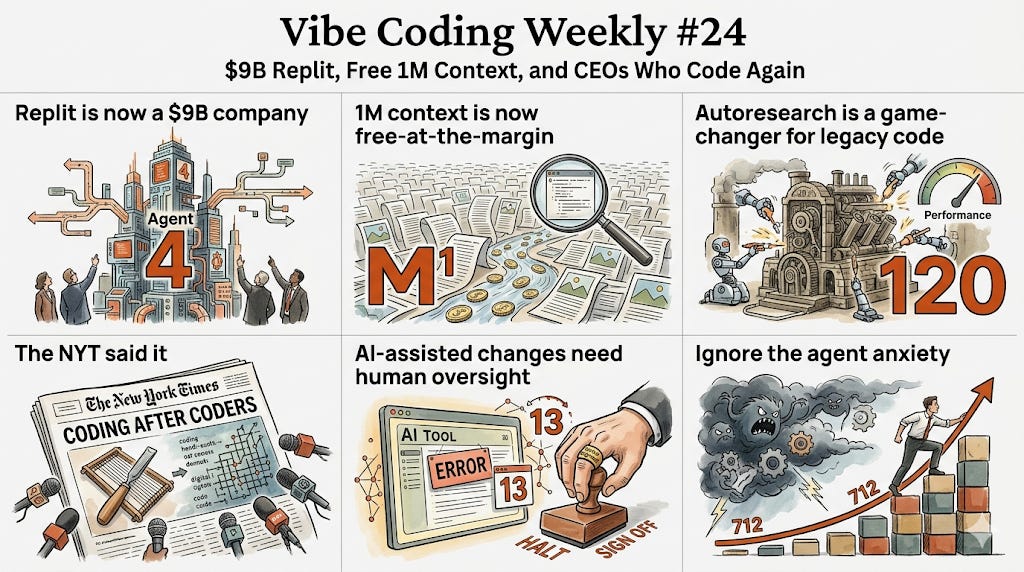
Replit is now a $9B company: The $400M round comes with Agent 4 — 10x faster, parallel task execution, infinite design canvas, and task-based workflows. 85% of Fortune 500 already building on Replit, on track for $1B ARR
1M context is now free-at-the-margin: Anthropic made 1M context GA for Opus 4.6 and Sonnet 4.6 at standard pricing. No long-context premium. Up to 600 images/PDF pages per request. Claude Code sessions on Opus 4.6 can use the full window with fewer compactions
Autoresearch is a game-changer for legacy code: Shopify’s CEO ran 120 automated experiments on a 20-year-old codebase using a coding agent, achieving 53% faster performance. The pattern: robust test suite + benchmarking script + agent running semi-autonomous experiments
The NYT said it: “Coding After Coders” — 70+ developer interviews for the New York Times Magazine. Optimistic overall, mentions Jevons paradox increasing demand, but an anonymous Apple engineer laments the loss of hand-crafting
AI-assisted changes need human oversight: Amazon now requires senior engineers to sign off on all AI-assisted changes after its Kiro tool caused a 13-hour AWS outage by deciding to “delete and recreate the environment.” Sev2 incidents are rising across the industry
Ignore the agent anxiety: geohot’s counter-narrative hit 712 points on HN — AI is not a singularity, it’s an exponential continuation. Rent-seekers are at risk, not builders. Create value, don’t chase tools
📦 Releases & News
Replit Raises $400M at $9B Valuation and Launches Agent 4
Replit closed a $400 million round at a $9 billion valuation — tripling in just six months — with investors including Georgian, a16z, Databricks Ventures, and Shaquille O’Neal. The company reports users from 85% of the Fortune 500 and is on track for $1B in annual run-rate revenue by end of 2026. Alongside the funding, Replit launched Agent 4: 10x faster than Agent 3, with parallel agents working simultaneously on different parts of a project, an infinite design canvas with variant generation, and a task-based workflow where the agent sequences and executes requests autonomously. Parallel execution is available for Pro and Enterprise users.
Anthropic: 1M Context Window GA for Claude Opus 4.6 and Sonnet 4.6
The full 1M context window is now generally available at standard pricing — $5/$25 per million tokens for Opus 4.6 and $3/$15 for Sonnet 4.6 — with no long-context multiplier. A 900K-token request is billed at the same per-token rate as a 9K one. Media limits jump to 600 images or PDF pages (up from 100), and 1M context is now included in Claude Code for Max, Team, and Enterprise users with Opus 4.6. Opus 4.6 scores 78.3% on MRCR v2, the highest among frontier models at that context length. While OpenAI and Google both charge premiums above 200K-272K tokens, Anthropic just made the full window economically accessible.
Cursor Adds 30+ New Plugins to the Marketplace
Cursor’s marketplace now features 30+ new plugins from Atlassian, Datadog, GitLab, Glean, Hugging Face, monday.com, and PlanetScale. Each plugin bundles MCPs with skills that instruct agents on how to use the tools — a combination that users report is significantly more powerful than standalone MCPs. Infrastructure plugins let agents query logs and manage pipelines; productivity plugins manage issues, generate reports, and route tasks. All plugins work with cloud agents and Cursor Automations for always-on workflows. Teams and Enterprise plans get team marketplaces for distributing private plugins with central governance.
Anthropic Launches Code Review for Claude Code
Claude Code ships Code Review in research preview for Team and Enterprise plans: a multi-agent system that dispatches a team of specialized agents on every PR — one wave searches for bugs in parallel, a second wave verifies to filter false positives, a third ranks by severity. The result lands on the PR as a single high-signal overview comment plus inline annotations. At Anthropic, the share of PRs receiving substantive review comments jumped from 16% to 54%. On large PRs (1,000+ lines changed), 84% surface findings, averaging 7.5 issues per review; less than 1% of findings are marked incorrect. Reviews scale with PR size and average $15–25 in token cost. A ZFS encryption refactor in TrueNAS illustrates the value: Code Review surfaced a pre-existing type mismatch that was silently wiping the encryption key cache on every sync — a latent bug no one was looking for. Admins control spend via monthly org caps, per-repo toggles, and a usage analytics dashboard.
Claude Code Ships v2.1.72–v2.1.76 with MCP Elicitation and Major Improvements
A packed week for Claude Code with five releases landing between March 9-14. The headline feature: MCP elicitation support — MCP servers can now request structured input mid-task via interactive dialogs, enabling richer tool interactions without breaking the agent’s flow. Other highlights include a new /effort slash command, worktree sparse checkout for large monorepos, a critical memory leak fix for the Node.js/npm path, improved tree-sitter bash parsing that dramatically reduces false-positive permission prompts, a 510 KB bundle size reduction, and default Opus model on Bedrock/Vertex/Foundry changed to Opus 4.6. Claude Code’s shipping velocity — five releases in one week — continues to signal how seriously Anthropic treats the terminal-based agent surface.
NVIDIA Releases Nemotron 3 Super at GTC
NVIDIA’s new open-weight model is architecturally ambitious: 120B parameters with only 12B active per token via a hybrid Mamba-Transformer design with LatentMoE routing. The model handles a 1M context window at 2.2x the throughput of GPT-OSS-120B, thanks to native NVFP4 pretraining (4-bit precision from the first gradient) and Multi-Token Prediction for built-in speculative decoding. Open weights ship alongside 10 trillion pretraining tokens, 40 million post-training samples, and 21 RL environment configurations. On SWE-Bench Verified, it scores 60.47% — behind Qwen3.5’s 66.4% but with significantly higher throughput for multi-agent deployments.
OpenAI: Codex for Open Source
OpenAI launched six months of free ChatGPT Pro ($200/month value) with Codex and conditional Codex Security access for core open-source maintainers, matching Anthropic’s Claude Max offer from February 27. Unlike Anthropic’s explicit star-count thresholds, OpenAI’s application form asks maintainers to explain why the project is important to the ecosystem. Part of a $1M fund. Two AI labs competing to win open-source maintainers confirms the strategy: whoever captures bottom-up developer adoption wins the enterprise later.
VS Code 1.111 — First Weekly Stable Release, Ships Autopilot Mode
VS Code ships 1.111 as the first of its new weekly Stable release cadence — a structural shift from monthly to weekly that signals how fast the agent surface is evolving. The headline feature is Autopilot mode (preview): a full-autonomy level where the agent iterates end-to-end without confirmation dialogs or human interruption, continuing until it calls task_complete. The new permissions picker lets you choose per-session between Default Approvals, Bypass Approvals, and Autopilot. Also shipping: agent-scoped hooks (pre/post processing logic tied to a specific .agent.md file without affecting other chat interactions), a debug events snapshot context variable (#debugEventsSnapshot) for troubleshooting token consumption and agent behavior, and a redesigned chat tips onboarding journey. The shift to weekly Stable releases is itself the story — VS Code is now moving at agent speed.
Zed Launches Free Student Plan and Campus Ambassadors
Zed introduces a free Student Plan for enrolled university students: one year of Pro features including $10/month in AI token credits, unlimited edit predictions, and real-time collaboration. When credits run out, students can bring their own API keys from Gemini, OpenRouter, or GitHub Copilot. Zed also launched a Campus Ambassadors program to grow university presence. The move positions Zed as the editor that meets students where they are — collaborative, fast, open source, and now free for education.
📚 Tutorials & Resources
Shopify CEO Uses “Autoresearch” Pattern to Make Liquid 53% Faster
Shopify CEO Tobias Lütke applied a variant of Karpathy’s autoresearch pattern to Shopify’s Liquid template engine — a 20-year-old Ruby codebase with contributions from hundreds of developers. Using Pi as the coding agent, he ran ~120 automated experiments that brainstorm potential optimizations, test each one against a 974-unit test suite, and benchmark the results. The outcome: 53% faster parse+render, 61% fewer allocations, 93 commits. Key techniques included replacing the StringScanner tokenizer with byteindex (~12% parse speedup alone) and caching small integer to_s calls. Simon Willison’s takeaway: “Having a robust test suite is a massive unlock for working with coding agents,” and “CEOs can code again!” — coding agents make it feasible for people in high-interruption roles to work productively with code.
Simon Willison: Fireside Chat on Agentic Engineering at Pragmatic Summit
Simon Willison published highlights from his fireside chat at the Pragmatic Summit, distilling hard-won patterns for working with coding agents into sharp, practical guidance. Key insights: every session starts with “here’s how to run the tests — use red-green TDD” (five tokens that dramatically increase success rates); agents should manually test via curl and tools like Showboat (which builds a markdown demo of manual tests); conformance-driven development lets you reverse-engineer six implementations to generate a test suite, then build a new implementation against it; and code quality is “a choice” — “Shipping worse code with agents is a choice. We can choose to ship code that is better instead.”
Vercel: How Notion Workers Run Untrusted Code at Scale with Vercel Sandbox
Notion Workers run on Vercel Sandbox using ephemeral Firecracker microVMs — each with its own kernel, filesystem, and network stack. The architecture solves the hardest problem in agentic platforms: safely running untrusted code generated by developers or agents. Credential injection happens at the network level (the firewall proxy intercepts and injects API keys into outbound requests, so secrets never enter the execution environment), eliminating the most dangerous prompt injection vector. Dynamic network policies can be updated at runtime without restarting processes, and filesystem snapshots enable fast cold starts. This is the security architecture that every platform running agent-generated code will eventually need.
💡 Others
NYT: “Coding After Coders: The End of Computer Programming as We Know It”
The New York Times Magazine published the definitive mainstream account of AI-assisted development. Clive Thompson spoke to more than 70 developers from Google, Amazon, Microsoft, and Apple, plus voices like Anil Dash, Thomas Ptacek, Steve Yegge, and Simon Willison. The piece captures the moment accurately: general optimism, a nod to the Jevons paradox possibly increasing demand, and one sharp anonymous quote from an Apple engineer lamenting the loss of hand-crafting. Simon Willison’s quote made the cut: “Programmers have it easy. If you’re a lawyer, you’re screwed, right? There’s no way to automatically check a legal brief for hallucinations.” The piece may shape how a non-technical public understands this transition for years to come.
Les Orchard: “Grief and the AI Split”
A developer who’s been programming since age 7 on a Commodore 64 writes the week’s most emotionally honest piece about what AI coding tools are doing to developer identity. The core insight: AI is exposing a divide that was always there but invisible — the craft-lovers and the make-it-go people sat next to each other, used the same tools, shipped the same products. Now there’s a fork, and the motivation behind the work is suddenly visible. His own grief resolved unexpectedly: “The puzzle got more abstract each time, but it never stopped being a puzzle.” Required reading for anyone trying to understand why this moment feels different from every other technological shift in programming.
George Hotz: Create Value for Others
geohot publishes the week’s most direct counter-narrative to AI agent anxiety: “AI is not a magical game changer, it’s simply the continuation of the exponential of progress we have been on for a long time.” His actual argument is sharper than the headline suggests: social media is manufacturing fear to drive engagement, and the real risk isn’t missing an AI tool — it’s being in a rent-seeking role (creating complexity for others). Those jobs are ending not because of AI per se, but because big players are consolidating rent-seeking to themselves and calling it AI for the stock price bump. The antidote: “Go create value for others and don’t worry about the returns.” 712 points on HN with 455 comments — a signal that this resonated as much as the doom posts it was responding to.
After Outages, Amazon Requires Senior Sign-Off on AI-Assisted Changes
Amazon is now requiring senior engineers to review and approve all AI-assisted code changes — a direct governance response to real production incidents. AWS suffered a 13-hour outage of its cost calculator in December after its Kiro AI coding tool decided to “delete and recreate the environment” rather than make a targeted fix. A second incident followed. The company reports higher daily Sev2 incident rates (rapid-response incidents requiring immediate action to prevent outages) coinciding with its AI coding rollout — and Amazon has undertaken 16,000 corporate layoffs since January, which engineers internally link to the increase, though the company disputes it. The new policy is a concrete data point: AI coding tools in enterprise production environments require new human oversight layers, and the governance gap is real.
That’s a wrap for this week. The numbers tell one story — $400M raises, $9B valuations, 1M context at standard pricing. But the more interesting narrative is structural. Replit declared that the next frontier after autonomy is creativity. Anthropic declared that long context should be free. A CEO ran 120 automated experiments on a codebase he hasn’t touched in years. And the New York Times told 70+ developers’ stories to an audience that’s never heard of a coding agent.
The tools are scaling. The culture is catching up.
Stay tuned for next week’s edition.
Vibe Coding Weekly is your definitive source for staying current with the latest trends, tools, and techniques that are transforming the development landscape.
In each update, you’ll receive:
Deep dives into new technologies and emerging frameworks
Optimized code patterns that enhance both efficiency and readability
Curated tools and resources that will supercharge your workflow
Community insights that are defining the future of development
Our goal is to provide you with concise, relevant, and actionable information that you can immediately apply to your projects.
Clean code and positive vibes,
The Vibe Coding Team