
Vibe Coding Weekly #34
More agentic coding launches in one week than any week this quarter — and the ROI questions are finally arriving.

This week in one satisfying refactor:
The Race Heats Up: xAI enters agentic coding with Grok Build 0.1, Mistral rebrands entirely as Vibe with a unified work-and-code agent, and Codex brings Computer Use to Windows — more direct competition in the same week than any week this quarter.
The Governance Shift: GitHub now lets enterprise admins assign specific AI models to specific organizations — model governance is no longer an afterthought, it’s a feature Copilot is actively selling to compliance-conscious CIOs.
The Counter-Narrative: Engineering leaders are quietly capping per-engineer AI budgets as ROI questions surface — the era of unlimited token spend is hitting its first real headwinds.
If you only read one thing this week: Claude Opus 4.8 is the most honest model Anthropic has shipped. It’s approximately four times less likely than Opus 4.7 to let flawed code pass unremarked, scores 69.2% on SWE-bench Pro (up from 64.3%), and introduces Dynamic Workflows in research preview — the ability to orchestrate hundreds of parallel subagents in a single session to complete codebase-scale migrations across hundreds of thousands of lines of code. Fast mode is now three times cheaper than it was on Opus 4.7. The 41-day release cycle from 4.7 to 4.8 signals something: the competition right now is forcing releases faster than the calendar intended. Read more →
Key Takeaways
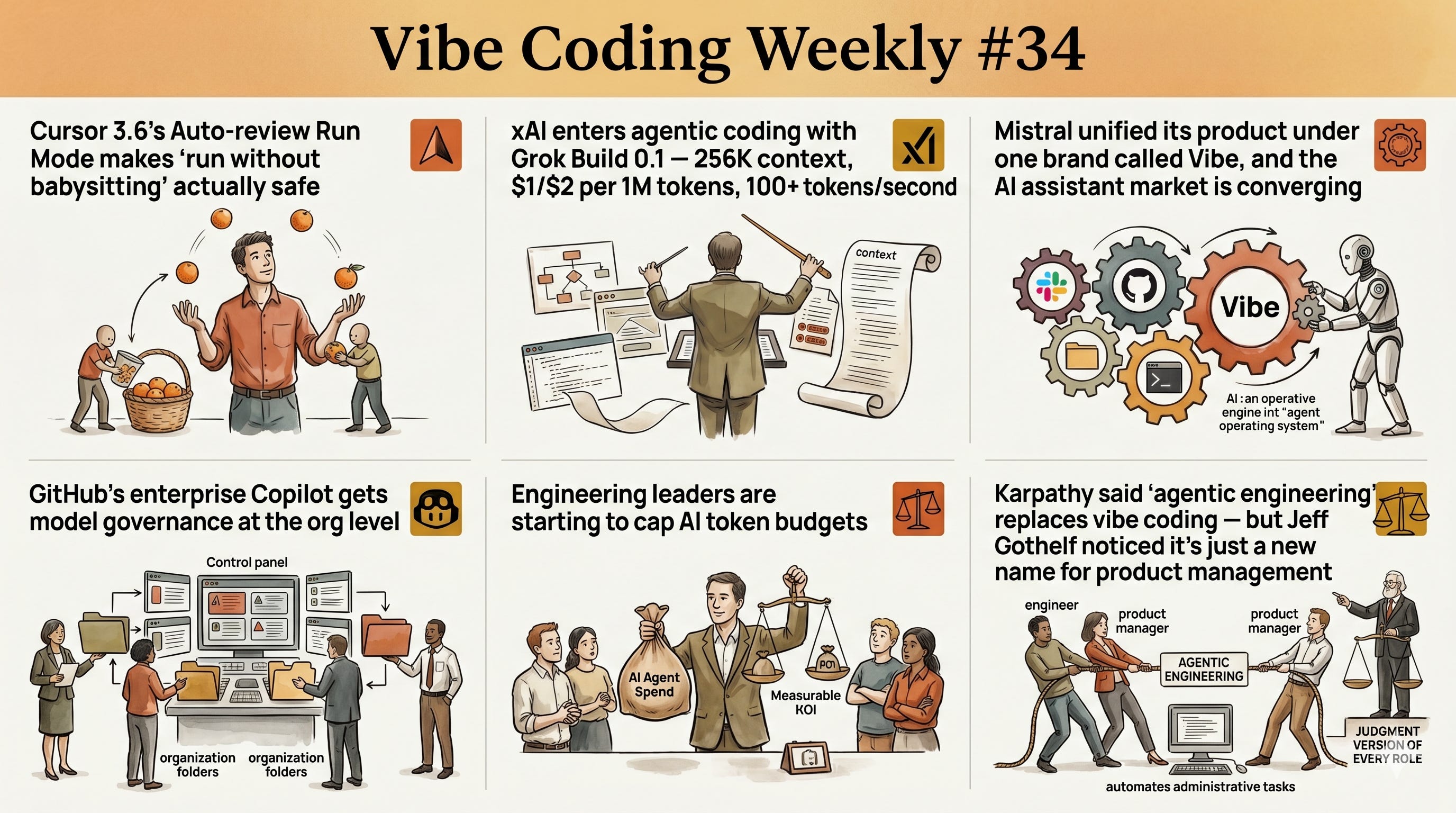
Cursor 3.6’s Auto-review Run Mode makes “run without babysitting” actually safe: A classifier subagent now evaluates every shell, MCP, and fetch call at runtime — allowlisted calls run immediately, sandboxable calls run in the sandbox, and everything else gets escalated to you. The result is fewer interruptions without the anxiety of full yolo mode. Read more →
xAI enters agentic coding with Grok Build 0.1 — 256K context, $1/$2 per 1M tokens, 100+ tokens/second: Unlike conversational Grok, this model is purpose-built for tool invocation and reasoning chains. It reads diagrams, UI mockups, and error screenshots, integrates with VS Code and JetBrains, and is already compatible with open-source agents like Hermes Agent and OpenClaw via OAuth. Read more →
Mistral unified its product under one brand called Vibe, and the AI assistant market is converging: Work Mode handles enterprise knowledge across Google Workspace, Slack, GitHub, and more; Code Mode runs remote coding agents and creates pull requests from a web surface or VS Code extension. Every Le Chat account carries over. The race is no longer between chat assistants — it’s between agent operating systems. Read more →
GitHub’s enterprise Copilot gets model governance at the org level: Admins can now assign specific models to specific organizations instead of applying a single enterprise-wide setting — a change that matters enormously for companies managing different compliance requirements across subsidiaries and teams. Read more →
Engineering leaders are starting to cap AI token budgets: The Pragmatic Engineer reports that mid-sized and large companies are dampening AI agent spend through per-engineer monthly limits. After two years of uncritical adoption, ROI scrutiny is arriving — and teams that haven’t measured what they’re getting from their AI spend are about to be asked to justify it. Read more →
Karpathy said “agentic engineering” replaces vibe coding — but Jeff Gothelf noticed it’s just a new name for product management: Writing design specs, supervising agent plans, writing tests, managing permissions — that’s the PM job description. The judgment version of every role is now the job. The administrative version is automatable. Both engineers and PMs need to decide which side of that line they’re on. Read more →
Growing at 20% new subscribers per week.
The stories this week aren’t hard to find. What’s hard is knowing which ones actually matter before your team asks you on Monday.
That’s the only thing Vibe Coding Weekly does: cut through the volume so you arrive at the week with context, not anxiety.
Subscribers also get Change Management in Agentic AI Adoption — the framework for the conversation that always comes after “we should use AI more”: how to actually move an organization that didn’t ask to be moved. Included with every subscription.
📦 Releases & News
Claude Opus 4.8 Now Available in GitHub Copilot
The same day Anthropic shipped Opus 4.8, it landed in GitHub Copilot for Pro+, Business, and Enterprise subscribers across VS Code, Visual Studio, JetBrains, Xcode, Eclipse, and GitHub’s web interface. Enterprise and Business admins must enable the policy in Copilot settings before their users can access it. A 15X premium request multiplier applies until Usage Based Billing launches June 1 — worth noting for teams already managing Copilot token consumption.
Claude Code v2.1.152–v2.1.158: Opus 4.8, Dynamic Workflows, and Auto-loading Plugins
Five releases in four days. The headlining changes: Opus 4.8 is now the recommended model with /effort xhigh for difficult tasks (v2.1.154, May 28); Dynamic Workflows let you ask Claude to plan work and run tens to hundreds of agents in a single session (same release); /code-review --fix now applies review findings directly to the working tree (v2.1.152, May 27); plugins in .claude/skills/ directories auto-load without needing marketplace publication (v2.1.157, May 29); EnterWorktree can switch between Claude-managed worktrees mid-session; and Auto mode arrives on Bedrock, Vertex, and Foundry for Opus 4.7 and 4.8 (v2.1.158, May 30).
Copilot Memory Gets Deletion Controls, Repo-Level Toggle, and CLI Commands
GitHub gave administrators and users more control over Copilot Memory: a new repository-level off switch lets admins disable memory entirely for a given repo from settings; deletion guidance now points users to the right place to remove a memory and downvotes entries; and three new CLI commands (/memory on, /memory off, /memory show) bring memory management into the terminal. Available to all paid Copilot plans in public preview.
Codex CLI 0.134.0 and 0.135.0: History Search, Vim Mode, and Computer Use on Windows
Two releases in rapid succession. 0.134.0 (May 26) adds local conversation history search with case-insensitive content matching, makes --profile the canonical selector across all CLI flows, and lets read-only MCP tools run concurrently via readOnlyHint. 0.135.0 (May 28) adds richer codex doctor diagnostics and named permission profiles. The May 29 app update brings the most notable change: Computer Use now works on Windows — Codex can see, click, and type in Windows desktop apps — plus remote control of Codex sessions from iOS, Android, or Mac.
Gemini CLI v0.44.0: Unified Auto Mode and Sublime/Emacs Support
The May 27 release merges all specialized Auto modes into a single unified mode, simplifying configuration for teams running mixed workflows. Native support for Sublime Text and Emacs Client arrives as first-class integrations, and new agent-tui and tui-tester skills enable programmatic testing and automation of terminal UI applications — useful for anyone building or testing TUI-based developer tooling.
📚 Tutorials and Resources
Dynamic Workflows Explained — What They Are and How to Use Them
Appwrite’s breakdown of Opus 4.8’s most consequential new feature: Dynamic Workflows let Claude plan and execute work across tens to hundreds of parallel subagents in a single session. The piece explains the practical use cases — codebase migrations across hundreds of thousands of lines, full-project refactors that would previously require manual task decomposition — and clarifies that this ships as a research preview available today in Claude Code. A useful orientation if you’re trying to understand when and why to reach for this versus a standard agentic flow.
Next week, the stack keeps moving. So does this newsletter. Fall behind one week, and you’ll spend the next three catching up.
Every week, a new model drops. A new agent framework ships. A new “this changes everything” thread goes viral. And you still have actual code to write.
Every Monday, you open your inbox and already know what matters. You’ve skipped three viral threads that turned out to be nothing. You know that Opus 4.8 can run hundreds of parallel subagents on your codebase in a single session, that engineering leaders are quietly starting to cap AI token spend, and that every AI assistant on the market is converging toward the same thing — an agent operating system — whether they admit it yet or not. You didn’t spend your weekend reading to know this. We did.
That’s what Vibe Coding Weekly is. For developers, architects, tech leads, and everyone building or managing software in the age of AI.
Clean code and positive vibes,
Angel.