
Vibe Coding Weekly #38
Fable 5 returns worldwide — and in the same seven days, Sonnet 5 becomes the default model, background agents the default mode, and Manual the default permission.

This week, compiled:
The Big Model: Claude Sonnet 5 launches with performance approaching Opus 4.8 at introductory $2/$10 per Mtok — now the default model inside Claude Code v2.1.197
The Agent: Claude Code background subagents run by default and auto-commit, push, and open draft PRs when they finish — your terminal now manages its own ticket queue
The Ecosystem: Kimi K2.7 Code becomes the first open-weight model in GitHub Copilot’s model picker, cracking open a platform that had been closed-weight since day one
If you only read one thing this week: The US government lifted export controls on Fable 5 and Mythos 5 on June 30. What matters more than the return itself is what Anthropic published alongside it: a cross-industry jailbreak severity framework (CJS-0 to CJS-4) co-developed with Amazon, Microsoft, and Google — the first attempt to give every lab, researcher, and regulator a shared language for how dangerous a jailbreak actually is. This is what AI safety governance looks like when it starts to get real. Read more →
Key Takeaways
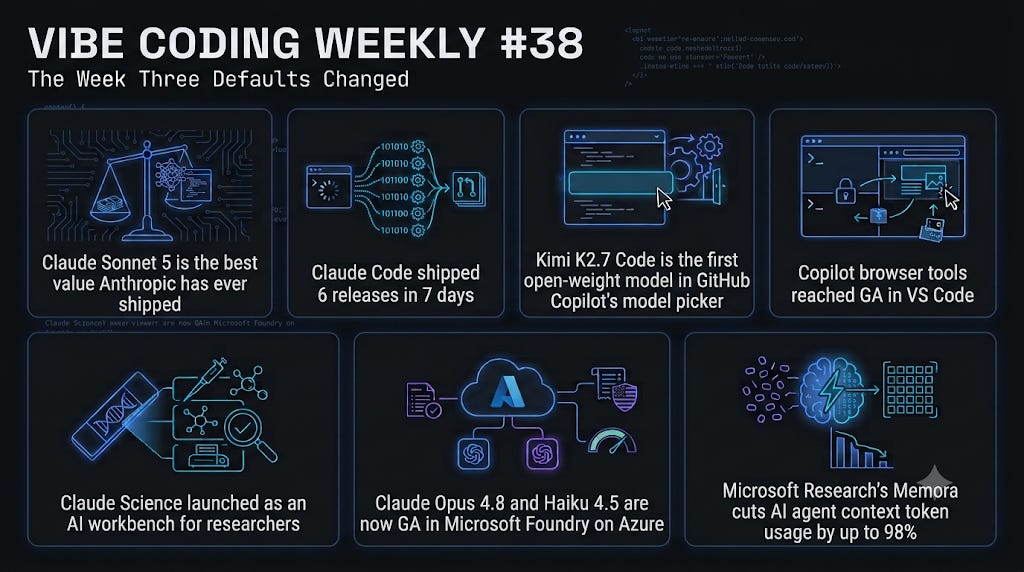
Claude Sonnet 5 is the best value Anthropic has ever shipped: near-Opus 4.8 performance, introductory pricing of $2 input / $10 output per Mtok through August 31, available across all plans and inside Claude Code as the new default. Read more →
Claude Code shipped 6 releases in 7 days, with v2.1.198 being the pivotal one: background subagents now run in parallel by default, auto-committing, pushing, and opening draft PRs when they finish. Claude in Chrome also hit general availability. Six releases, one week, fundamentally different terminal. Read more →
Kimi K2.7 Code is the first open-weight model in GitHub Copilot’s model picker — available now for Pro, Pro+, and Max; requires admin opt-in for Business and Enterprise. It’s one switch, but it signals a structural shift in how GitHub thinks about model diversity on the platform. Read more →
Copilot browser tools reached GA in VS Code: agents can now navigate, click, type, take screenshots, and feed live web content directly back into chat — with user-controlled tab sharing and fully isolated sessions that have no access to your cookies or browsing history. Read more →
Claude Science launched as an AI workbench for researchers with 60+ pre-configured skills across genomics, proteomics, and cheminformatics, a reviewer agent that checks citations and flags errors, and scaling from laptops to HPC clusters. Applications open through July 15 for up to $30K in credits per project. Read more →
Claude Opus 4.8 and Haiku 4.5 are now generally available in Microsoft Foundry on Azure, with Azure-native billing, authentication, networking, and US data residency. Eligible customers with a Microsoft Enterprise Agreement can draw Claude usage down against their existing Azure commitment. Read more →
Microsoft Research’s Memora cuts AI agent context token usage by up to 98% using a harmonic memory architecture that decouples what is stored from how it’s retrieved — achieving state-of-the-art memory accuracy (87.4% on LongMemEval) while storing half the memory entries of Mem0 per conversation. As agentic coding tools make 10–100x more LLM calls than chatbots, techniques like Memora are becoming the FinOps layer for AI teams. Code is on GitHub; paper presented at ICML 2026. Read more →
The stories this week aren’t hard to find. What’s hard is knowing which ones actually matter before your team asks you on Monday.
That’s the only thing Vibe Coding Weekly does: cut through the volume so you arrive at the week with context, not anxiety.
Subscribers also get Change Management in Agentic AI Adoption — the framework for the conversation that always comes after “we should use AI more”: how to actually move an organization that didn’t ask to be moved. Included with every subscription FOR FREE.
📦 Releases & News
More details on Fable 5’s cyber safeguards and our jailbreak framework
Anthropic — July 2, 2026
Two days after Fable 5’s return, Anthropic published the technical details most developers will actually want. The model’s cybersecurity classifier now divides use cases into four tiers — from outright prohibited (ransomware, malware, exfiltration) to benign IT work (secure coding, patch management) — with the classifier accepting higher false-positive rates in favor of safety margin. Separately, the Cyber Jailbreak Severity (CJS) framework scores any reported jailbreak across four axes: capability gain, breadth of enabling offensive tasks, ease of weaponization, and discoverability, producing a score from CJS-0 (Informational) to CJS-4 (Critical). The framework is co-developed with Amazon, Microsoft, and Google, and is designed to be adopted across labs — not just Anthropic.
Claude Code v2.1.200 — Manual permissions as the new default
Anthropic — July 3, 2026
The quietest but most consequential change in the week’s shipping sprint: Claude Code’s default permission mode is now “Manual” across CLI, VS Code, and JetBrains. AskUserQuestion dialogs no longer auto-continue (you can re-enable idle timeout via /config). The release also fixed background session failures after sleep/wake cycles, resolved subagents cut off by rate limits returning empty results instead of errors, and improved terminal rendering under tmux 3.4+. For teams running unattended agents, these reliability fixes matter as much as any feature.
OpenCode v1.17.12 and v1.17.13 — Sonnet 5 adaptive thinking and new model picker
OpenCode — June 30 and July 1, 2026
OpenCode shipped two releases in two days to respond to the Sonnet 5 launch. v1.17.12 enables adaptive thinking for Claude Sonnet 5 alongside improved MCP OAuth (refresh-token scope, better error surfaces) and token/cost totals visible in session context. v1.17.13 adds a searchable v2 model picker with model management flow, session tab hover previews showing project, path, branch, and server at a glance, and streamlined WSL server setup. Taken together: OpenCode turned around Sonnet 5 compatibility in under 24 hours of the model going live.
Google launches Nano Banana 2 Lite and Gemini Omni Flash
Google Blog — June 30, 2026
Two developer-facing models shipped the same day as Sonnet 5. Nano Banana 2 Lite is Google’s fastest and cheapest image model — 4-second generation times at $0.034 per 1K images, available immediately in Google AI Studio and the Gemini API. Gemini Omni Flash enters public preview as a natively multimodal video generation model supporting conversational editing from text, image, and video inputs at $0.10 per second of output. Both are accessible through the Gemini API, Google AI Studio, and the Enterprise Agent Platform starting today.
Copilot CLI no longer needs a PAT in GitHub Actions
GitHub Changelog — July 2, 2026
A simple change that removes significant operational overhead: GitHub Copilot CLI in Actions now authenticates with the built-in GITHUB_TOKEN, requiring only the copilot-requests: write permission. Personal access tokens — long-lived credentials that create security exposure and rotation headaches at scale — are no longer needed. AI credits bill directly to the organization. If your CI uses Copilot CLI today, this is a drop-in improvement with no behavior change.
Introducing Laguna XS 2.1
Poolside — July 2, 2026
As frontier API costs become harder to justify at scale, the open-weight option keeps getting better. Poolside’s Laguna XS 2.1 is a 33B-parameter MoE model that runs on a single GPU, achieves 63.1% on SWE-bench Multilingual (+5.4 points over its predecessor), and is available free on Hugging Face and OpenRouter under the fully permissive OpenMDW-1.1 license. For teams that need local agentic coding — private codebases, air-gapped environments, or simply more predictable infrastructure costs — Laguna XS 2.1 is a credible alternative to frontier API tools, deployable via Ollama, llama.cpp, vLLM, or TensorRT-LLM, with a paid hosted tier at $0.10/$0.20 per Mtok if you prefer not to self-host.
💡 Others
Copilot agent session streaming is now in public preview
GitHub Changelog — July 2, 2026
Enterprise visibility into agent activity just became possible. GitHub Enterprise Cloud customers can now stream Copilot agent session data — every prompt, response, and tool call — across all Copilot clients to a SIEM, event collector, or Microsoft Purview endpoint. Alternatively, pull up to 48 hours of records on-demand via REST API. As agents become standard in enterprise workflows, having an audit trail for what they did and why is increasingly non-negotiable — this is the first version of that answer from GitHub.
Upcoming deprecation of Gemini 2.5 Pro and Gemini 3 Flash in GitHub Copilot
GitHub Changelog — July 2, 2026
Action required if your team uses Gemini models via Copilot: GitHub has announced the upcoming deprecation of both Gemini 2.5 Pro and Gemini 3 Flash from the Copilot model picker. Teams relying on either should plan a migration to Gemini 3 Pro or an alternative in the picker before the deprecation date. Given the simultaneous announcement that Kimi K2.7 Code is now available, this week’s GitHub Copilot model story is really about the picker becoming a more dynamic surface — older models out, new open-weight options in.
This was a week where the word “default” did a lot of work. Sonnet 5 is now the default model in Claude Code. Background agents are now the default operating mode. Manual permissions are now the default safety posture. Anthropic shipped six releases in seven days, and each one quietly changed what it means to open a terminal. Meanwhile, Fable 5 came back — and what came with it was the first real attempt at a shared industry standard for measuring how dangerous a jailbreak is. A government suspended a model for three weeks and a cross-company safety framework came out the other side. And in the background, a Microsoft Research team published a paper showing you can cut your agent’s context token bill by 98% — because as your agents get more capable, the question of what they cost per task is no longer optional.
Next week, the stack keeps moving. So does this newsletter. Fall behind one week, and you’ll spend the next three catching up.
Every week, a new model drops. A new agent framework ships. A new “this changes everything” thread goes viral. And you still have actual code to write.
Every Monday, you open your inbox and already know what matters. You’ve skipped three viral threads that turned out to be nothing. You know Fable 5 is back globally, why it was suspended, and what the CJS framework means for every lab that ships frontier models. You know Claude Sonnet 5 benchmarks near Opus 4.8 at less than half the price, that Claude Code is now opening your pull requests in the background, and that Microsoft Research just published a technique to cut your agent’s token bill by 98%. You didn’t spend your weekend reading to know this. We did.
That’s what Vibe Coding Weekly is. For developers, architects, tech leads, and everyone building or managing software in the age of AI.
Clean code and positive vibes,
Angel.