
Vibe Coding Weekly #39
Three frontier AI coding models launched in 48 hours as manual code review collapses and token spend becomes the new cost lever.

This week, compiled:
The Data: The share of developers who stopped manually reviewing AI-generated commits jumped from 10% to 40% in a single month
The Money: Bun rewrote a core subsystem in Rust with AI in 11 days for $165K in tokens — work estimated at a year for a small human team
The Trend: Token budgets, not headcount, are the flexible line item — one security firm cut LLM spend 59–70% by fixing its cache hit rate
If you only read one thing this week: Three frontier labs shipped coding-capable models within a single 48-hour window. OpenAI took GPT-5.6 to general availability on July 9 as a three-tier family — Sol (flagship), Terra (balanced), and Luna (fast/cheap) — landing in ChatGPT, Codex, and the API, one day after xAI’s Grok 4.5 and the same day as Meta’s Muse Spark 1.1. If your team standardized on a model last quarter, this is the week that decision reopened. Read more →
The stories this week aren’t hard to find. What’s hard is knowing which ones
actually matter before your team asks you on Monday.
That’s the only thing Vibe Coding Weekly does: cut through the volume so you
arrive at the week with context, not anxiety.
Subscribers also get Change Management in Agentic AI Adoption — the framework
for the conversation that always comes after “we should use AI more”: how to
actually move an organization that didn’t ask to be moved. Included with every
subscription.
Key Takeaways
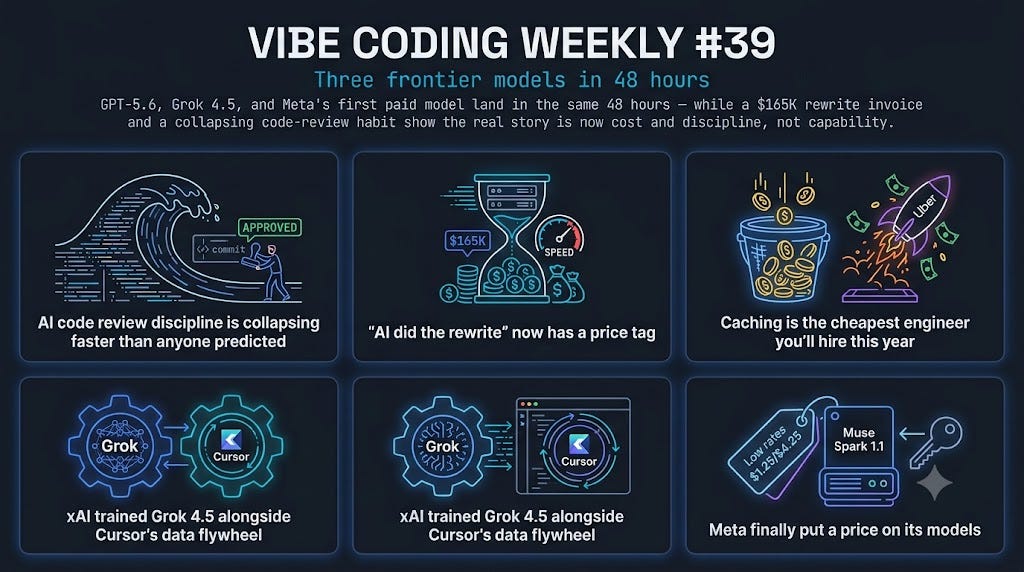
AI code review discipline is collapsing faster than anyone predicted: median Cursor users generate ~700 lines of code weekly while the top 1% generate 30,000–40,000 lines (roughly 45 median developers’ worth) — and the share of developers who no longer manually review AI-generated commits quadrupled to 40% in March 2026 alone. Read more →
“AI did the rewrite” now has a price tag: Bun’s AI-assisted Rust rewrite of a core subsystem took 11 days and $165K in tokens, versus an estimated year for a small human team — one of the first public case studies with hard cash numbers instead of anecdote. Read more →
Caching is the cheapest engineer you’ll hire this year: security firm ProjectDiscovery raised its cache hit rate from 7% to 84% and cut LLM spend 59–70% — while Uber handed AI tools to 5,000 engineers and burned its entire 2026 AI budget by April. Read more →
xAI trained Grok 4.5 alongside Cursor’s data flywheel — a rare public confirmation of a frontier lab and an agentic IDE co-training a model, blurring the line between model provider and tool vendor. Read more →
Meta finally put a price on its models: Muse Spark 1.1 is Meta’s first paid model — 1M-token context at $1.25/$4.25 per million tokens, roughly a quarter of Anthropic and OpenAI’s rates, launched via a new public-preview Meta Model API. Read more →
📦 Releases & News
Claude Code Ships Six Releases in a Week (v2.1.202 → v2.1.207)
Claude Code enabled auto mode by default on Bedrock, Vertex AI, and Foundry (opt-out via disableAutoMode), bumped Bedrock to Opus 4.8, and reworked agent-view rows to show classifier-written headlines instead of raw tool-call text. The fixes matter too: a terminal freeze on long streamed outputs, a consent-dialog bypass on remote managed settings, and an auto-updater bug that clobbered custom launcher symlinks. If you run Claude Code through a cloud provider, the new default is worth a deliberate look before your next session.
OpenAI Codex Enables Remote Plugins by Default, Joins ChatGPT Desktop
Across CLI 0.143.0–0.144.1 (July 6–9), Codex turned on remote plugins by default with a richer catalog and proxy-aware auth on macOS/Windows, added Bedrock GPT-5.6 models, and shipped configurable rollout token budgets that abort a turn when the budget is exhausted — a native cost-control primitive landing directly in the agent. Codex also moved into the ChatGPT desktop app, letting users edit code and review PR diffs without leaving ChatGPT.
OpenCode Adds Code-Mode MCP Adapter, Fixes Copilot Pricing Crash
Across four releases (July 7–9, through v1.17.18), OpenCode shipped a code-mode MCP adapter, a v2 free-model selector for faster access to more providers, and broad desktop/TUI workflow fixes. The most instructive item is a crash caused by GitHub Copilot returning models with a zero billing batch size — a reminder that provider-side pricing metadata bugs can break your agents downstream, whether or not you touched anything.
Gemini CLI v0.50.0 Adds Tool Registry Discovery
The stable v0.50.0 release (July 8) introduced tool registry discovery for automatic detection and registration of tools, plus CI pipeline safeguards to stop bad npm releases from shipping. A same-day preview (v0.51.0-preview.0) hardened path-resolution security for at-reference files — a quiet but meaningful fix given how much context flows through file references in agent sessions.
GitHub Copilot in VS Code Ships Agentic Browser Tools, Parallel Sessions
VS Code’s Copilot agent can now browse and validate web apps directly (agentic browser tools are GA), run multiple parallel agent sessions with separate chats, and expose session-level and subagent-level credit cost tracking — cost observability arriving as a first-class IDE feature, not an afterthought. A new Language Models editor also lets you discover and install model-provider extensions on the fly.
Cursor 3.11 Adds Side Chats and Agent Transcript Search
Cursor 3.11 (July 10) lets you branch off a side chat (via /side, /btw, or a plus button) to explore tangents without derailing the main agent conversation, and adds full-text search across past agent transcripts. New cloud-agent hooks (beforeSubmitPrompt, afterAgentResponse, afterAgentThought) give teams programmatic visibility into agent runs — the audit layer enterprises keep asking for.
Zed Adds llama.cpp as a Model Provider, Day-One GPT-5.6 Support
Zed 1.10 (July 8–10, three releases) added llama.cpp as a first-class language model provider — a notable nod to local and self-hosted model workflows — and unified LLM providers, external agents, and MCP servers into a single settings editor. Within 24 hours of GPT-5.6’s release, Zed shipped support for Sol and Terra, with Luna pending third-party API access.
💡 Others
Tech Jobs Market in 2026, Part 3: Hiring Managers & Job Seekers
The Pragmatic Engineer examines how AI adoption is reshaping engineering hiring: which AI-related roles are hottest, and why conditions remain tough for engineering leaders despite strong demand for AI skills. Worth reading if you’re on either side of the hiring table — the skills premium is real, but it isn’t landing where most job seekers expect.
The arc of this week is simple: the models multiplied, and the money got named. Three frontier launches in 48 hours would have been the whole story a year ago — this week it shared the stage with a $165K rewrite invoice, a cache hit rate that saved more budget than a layoff round, and 40% of developers waving AI commits through unreviewed. The tools are no longer the bottleneck. The economics and the discipline are.
Next week, the stack keeps moving. So does this newsletter. Fall behind one week, and you’ll spend the next three catching up.
Every week, a new model drops. A new agent framework ships. A new “this changes
everything” thread goes viral. And you still have actual code to write.
Every Monday, you open your inbox and already know what matters. You’ve skipped
three viral threads that turned out to be nothing. You know which of the three new frontier models actually changes your team’s pricing math, and you know that the scariest number this week wasn’t a benchmark — it was 40% of developers no longer reviewing AI commits. You didn’t spend your weekend reading to know this. We did.
That’s what Vibe Coding Weekly is. For developers, architects, tech leads, and
everyone building or managing software in the age of AI.
Clean code and positive vibes,
The Vibecoding Team.