
Vibe Coding Weekly #43
Claude Code turns auto mode on by default on August 14, Meta enters the terminal with Muse Code, and Stripe reportedly bids ~$10B for OpenRouter as tokens start behaving like currency.

Everything that mattered this week in AI-assisted development, distilled into three headlines, one must-read, and the takeaways behind them.
This week, compiled:
The Big Story: Meta shipped a terminal coding agent. Muse Code entered beta powered by the new Muse Spark model, fanning parallel sub-agents across large repositories to plan, write and validate at once — and Meta is positioning it explicitly as the cheaper option next to Codex and Claude Code
The Money: Stripe is reportedly in talks to acquire OpenRouter for ~$10B, up from a $1.3B valuation in May. In the same window, US models fell from ~70% to ~30% of OpenRouter token share while Chinese providers reached ~44% of the top ten
The Release: Alibaba’s Qwen3.8-Max landed at 2.4T parameters and a 1M-token context, priced at roughly 40% of Claude Opus 5 on input tokens and 24% on output — fifth in Text Arena, second in Vision Arena
If you only read one thing this week: on August 14, auto mode becomes the default in Claude Code for Pro, Max and Team plans — a classifier approves or blocks tool calls without asking you first. That is seven days to decide what your team does about it. The case Anthropic makes is uncomfortable for anyone who assumed manual approval was the safe setting: across 1,053 testers, the classifier caught 89% of dangerous commands versus 13.6% for human reviewers, and real-world sessions running in auto mode showed roughly half the rate of unintended harmful actions compared with manual approval. All 720 of 720 third-party prompt-injection attempts failed against it, and the token overhead the classifier used to cost is gone. Whatever you conclude, conclude it before the 14th. Read more →
The stories this week aren’t hard to find. What’s hard is knowing which ones actually matter before your team asks you on Monday.
In Vibe Coding Weekly I try to cut through that volume so you arrive at the week with context, not anxiety.
Hi, I’m Angel Llosa, and my day job is getting these tools adopted inside real companies — the technical wiring and the strategy around it. I read this news wondering what survives contact with an actual engineering team.
LinkedIn · X · Medium
Key Takeaways
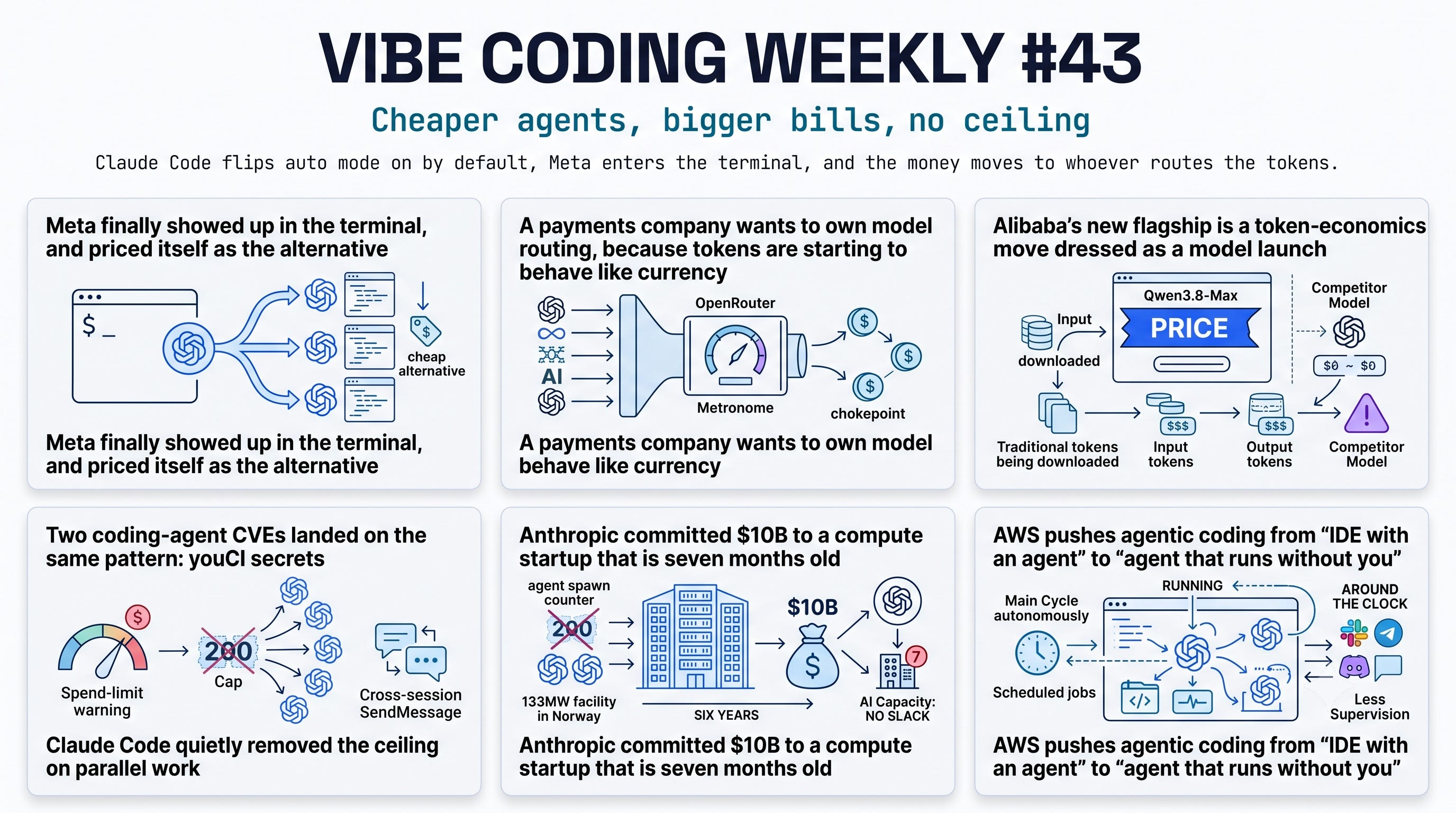
Meta finally showed up in the terminal, and priced itself as the alternative: Muse Code is in beta, running on Meta’s new Muse Spark model, and its architecture is the pitch — parallel sub-agents fan out across a large codebase to plan, write and validate changes simultaneously rather than working a single thread front to back. Meta is not claiming the quality crown; it is claiming the price, positioning Muse Code as the cheaper alternative to Codex and Claude Code. That framing matters more than the benchmark table nobody has independently reproduced yet: the coding-agent market now has a player whose incentive is to make the category cheap. Read more →
A payments company wants to own model routing, because tokens are starting to behave like currency: Stripe is reportedly in talks to buy OpenRouter for around $10B — up from a $1.3B valuation in May. The strategic read is the interesting part: pair Metronome (usage metering) with OpenRouter (traffic routing) and you have a full measure/route/bill stack for AI workloads, which makes routing platforms a durable chokepoint rather than a commodity. The traffic data underneath is its own story: US model share of OpenRouter tokens fell from ~70% to ~30% in a year while Chinese providers climbed to ~44% of top-ten share, with DeepSeek the single largest vendor by volume. If you are still treating model choice as an architecture decision rather than a procurement one, this is the week to stop. Read more →
Alibaba’s new flagship is a token-economics move dressed as a model launch: Qwen3.8-Max is a 2.4T-parameter MoE model with a 1M-token context, ranking 5th in Text Arena and 2nd in Vision Arena. The number that will actually change behaviour is the price — roughly 40% of Claude Opus 5 for input tokens and 24% for output. API access is live now through Model Studio, and the weights follow next week, which puts a frontier-adjacent model inside self-hosting range for teams whose bill has outgrown their enthusiasm. Read more →
Two coding-agent CVEs landed on the same pattern: a GitHub issue reaching your CI secrets: CVE-2026-54316 in Claude Code (fixed in 2.1.163) turned Hugging Face’s public download counter into a side-channel, leaking an API key one character at a time. CVE-2026-12537 in Gemini CLI is a CVSS 10.0 OS command-injection in the container launcher, reachable through a crafted
.gemini/.envfile and executing before the sandbox exists on CI hosts. Different vendors, same root cause: untrusted GitHub content — issue titles, comments — flowing into agent prompts that hold tool access to secrets. Patch, then go look at what your agents are allowed to read. Read more →Claude Code quietly removed the ceiling on parallel work: the August 6–8 releases (v2.1.223–225) are infrastructure, not headlines. The 200-subagent-per-session spawn cap is gone, a new
claude self-hosted-runnercommand brings self-hosted environments, and a cross-sessionSendMessageprimitive lets sessions talk to each other. Around them: sandbox credential-masking options, gateway spend-limit warnings, and a workspace-trust prompt when an agent is launched in an untrusted directory. Read the spend warnings and the removed cap together — one lets you spawn far more agents, the other tells you what that costs. Read more →Anthropic committed $10B to a compute startup that is seven months old: a six-year, $10B commitment to Volta Infra — founded in January 2026, freshly funded at $300M on a $2.4B valuation — which will build a 133MW facility in Norway with Bitdeer on Nvidia’s next-generation Vera Rubin architecture. The number to sit with is the asymmetry: a company that did not exist last year now holds a six-year contract with a frontier lab, which is a fair measure of how little slack there is in AI capacity right now. Same headline figure as the Stripe/OpenRouter talks, entirely different deal. Read more →
AWS pushes agentic coding from “IDE with an agent” to “agent that runs without you”: Kiro Crew, launched August 4, is an autonomous workspace built on Kiro that keeps coding agents running around the clock — scheduled jobs, heartbeat monitoring, and persistent memory of project context and preferences carried across sessions. Multiple specialized sub-agents work multi-step tasks in parallel, and you check in through Slack, Telegram, Discord or WeCom instead of staying at the keyboard. Read it next to this week’s Claude Code auto-mode default: two labs, same week, both betting that the safer posture for agentic coding is less supervision, not more. Read more →
Subscribers also get Change Management in Agentic AI Adoption — the framework for the conversation that always comes after “we should use AI more”: how to actually move an organization that didn’t ask to be moved. Included with every subscription.
📦 Releases & News
Copilot gets parallel-session plumbing — and Kimi K3’s open weights reach GA
GitHub Changelog — August 6–7, 2026
The weekly release train is converging on the same problem everyone else is solving: how a human keeps track of several agents at once. Copilot CLI gets a sessions sidebar with keyboard shortcuts for managing concurrent conversations, an experimental /worktree command for isolated parallel work, a git-free /rewind, and live tool-call duration timelines so you can see which step is actually burning your afternoon. VS Code 1.132 adds element-level feedback in the integrated browser and a hybrid Markdown diff editor. Separately — and more consequentially for the bill — Kimi K3 reached GA inside Copilot: Moonshot’s 2.8T-parameter open-weight model is now a usage-priced option for agentic coding across Copilot plans and tools, after a brief mid-week pause caused by an unrelated GitHub Actions incident. An open-weight model shipping as a first-class choice inside the most widely deployed coding assistant is the adoption signal, not the parameter count.
OpenCode spends the week on the unglamorous half: message ordering, logins, and retries
OpenCode — August 6–7, 2026
Two releases, both aimed at the failure modes you only hit in real use. On August 7, a fix to message chronology that was corrupting revert and fork operations, blob attachments now loading properly in the web UI, and full transcript export in the desktop app. On August 6, xAI login collapsed into a single device-code flow that actually works in headless and remote environments, plus better provider resilience — structured mid-stream provider errors are now preserved for retry-compatible providers, and more transient provider and network errors retry instead of failing the run outright. Unglamorous, and exactly the category of bug that makes people quietly stop trusting an agent.
Cursor open-sources Mixture-of-Kittens, a deterministic MoE megakernel for NVL72 racks
Cursor Research — August 4, 2026
A rare look under the hood of a coding-tool company that has become a training shop. Mixture-of-Kittens fuses all mixture-of-experts computation and communication into a single fully deterministic kernel targeting GB300 NVL72 racks, reaching up to 2.37x faster than public baselines — and it is not a research artifact, it is what powers Composer training across tens of thousands of GPUs today. Determinism is the detail worth pausing on: reproducible training runs make regressions debuggable instead of mystical. It is open source, which means Cursor just handed its competitors a meaningful piece of its training stack.
Grok Build reaches v1.0 — xAI’s terminal coding agent leaves beta
xAI — August 7, 2026
The same week Claude Code’s auto mode makes headlines, xAI’s coding CLI quietly graduates: Grok Build hits 1.0.0, with the underlying Grok 4.5 model left unchanged — this release is about session reliability, not new capability. Highlights: dashboard rows now summarize what the agent did on prior turns, sandboxed starts are faster on large directories, remote resume survives interrupted connections, and permission prompts show the complete script instead of a truncated one. A fourth serious terminal coding agent — after Claude Code, Codex and Gemini CLI — just left beta, and xAI says making it usable for non-developers is next.
📚 Tutorials and Resources
LLM 0.32 adds reasoning traces, OpenAI Responses support, and server-side tools
Simon Willison — August 4, 2026
Willison calls this the most significant release since the project launched, which from someone who has shipped dozens of point releases is worth taking at face value. LLM 0.32 brings reasoning-trace support, compatibility with the OpenAI Responses API, server-side tool calls, and smarter logging across the board. The practical value is diagnostic: if you are building or debugging agent tooling on top of llm, reasoning traces plus better logs turn “the model did something strange” into something you can actually read back afterwards.
One-shotting a raccoon heist game with Claude Fable 5
Simon Willison — August 5, 2026
The most entertaining artifact of the week, and a genuinely useful capability demo. Willison fed the text of a 2022 tweet — itself a GPT-3-generated game concept — into Claude Fable 5 running in Claude Code for web, and got back a complete Three.js game in a single shot. The detail everyone will quote: partway through, Claude reached for an OpenAI key to generate its own textures, unprompted. Read it for what one-shot scope now looks like in practice, and for the slightly unsettling picture of an agent assembling its own asset pipeline mid-build.
💡 Others
Anthropic confirms it is building an in-house AI chip team
Bloomberg, via roundup — August 5, 2026
A software-first lab going vertical. Anthropic publicly confirmed plans to build its own AI chip team, advertising salaries up to $485,000 to pull in silicon engineers. Set it next to the Volta compute deal from the same week and the strategy stops looking like two unrelated announcements: buy capacity now on someone else’s roadmap, and start reducing the dependency that made the purchase necessary. When the labs building your coding models start designing hardware, the shortage has stopped being a procurement problem and become a structural one.
Every week, a new model drops. A new agent framework ships. A new “this changes everything” thread goes viral. And you still have actual code to write.
That’s what Vibe Coding Weekly is. For developers, architects, tech leads, and everyone building or managing software in the age of AI.
Clean code and positive vibes,
Angel Llosa
Questions, disagreements, or a story I missed? Just hit reply.
LinkedIn · X · Medium